
Don’t Overshoot
Reflections on a Wedding, Part One

It’s almost eleven. The welcome party should be winding down soon, but the energy is still strong and building. Espresso martinis are flowing, and the magicians keep dealing wonder. I’d been sick the week before the wedding and was still not 100%. My photographer, John, came up to me and tapped me on the shoulder. He said, “We’re heading out. We don’t want to overshoot.”
I’ve thought of this phrase every day since. Shortly after John, I left the party early as well. I’d had the most incredible night, but I too didn’t want to overshoot.


There’s a famous psychology study — the jam study — that changed the way researchers think about choice. When shoppers were presented with a table of 24 jams, they were far less satisfied with their selection than shoppers who chose from just 6.1 More options didn’t make people happier. It made them wonder if they’d picked the wrong one.
There’s another study I love even more, done in a photography class. In Group A, students were told to pick their single best photo, but they could always come back and change their minds. In Group B, students picked one photo and were told they could never change it. Over time, Group B was far more satisfied with their choice. Not because they picked better — but because the constraint freed them from second-guessing.2
More isn’t better. More choices, more content, more photos, more chances to revise — it all sounds like freedom, but it’s a trap. The thing John understood when he tapped me on the shoulder is the thing these studies keep proving: there is a point of enough, and it often comes earlier than we think.
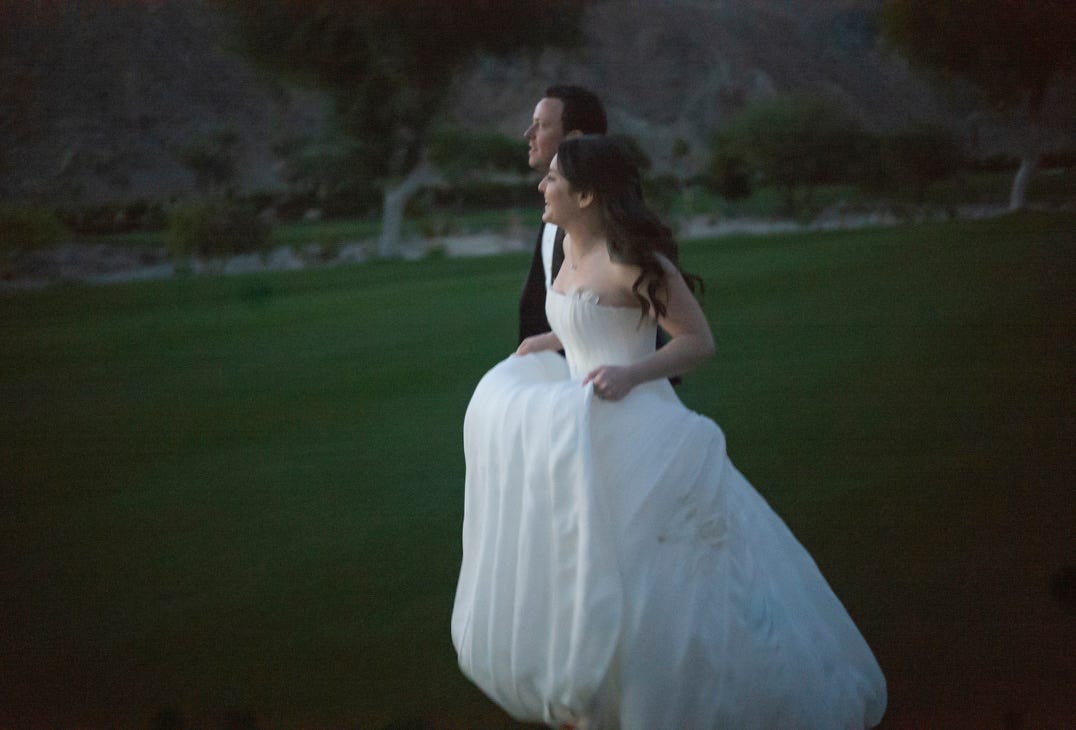
Social media has really changed the wedding industry.
Today, weddings have two lives. The experience of being there, and the process of packaging it up to be experienced by others. Social media has created this constant tension between living in the moment and capturing it for later consumption. My question is: consumption by whom? Who is the intended audience of my wedding photographs and why?
Before social media, I assume families were the primary audience of wedding photos. Photographs framed on the walls of homes. Coffee table books of memories for families to page through over a glass of wine.
For the better part of the last century, magazines and publications have been glamorizing weddings — Brides, originally titled So You’re Going to Be Married, launched in 1934, and Martha Stewart’s famous Weddings magazine hit the newsstands in the 90s. But the sheer volume of wedding content I consumed on Instagram and Pinterest while planning our wedding was dizzying.
And it’s not just strangers’ weddings. Through social media, I know it rained at a high school friend’s wedding in Colorado. That a girl in my graduating class from Stanford had celebrity performances. That my college best friend, who I no longer talk to, wore a lace ballgown to marry the guy she met on Hinge. Social media has made me an audience member at the weddings of people I no longer know.
When answering the question of how we want this day captured, you can feel the role social media plays. The societal pressure isn’t just to plan a beautiful wedding. It’s to perform one.


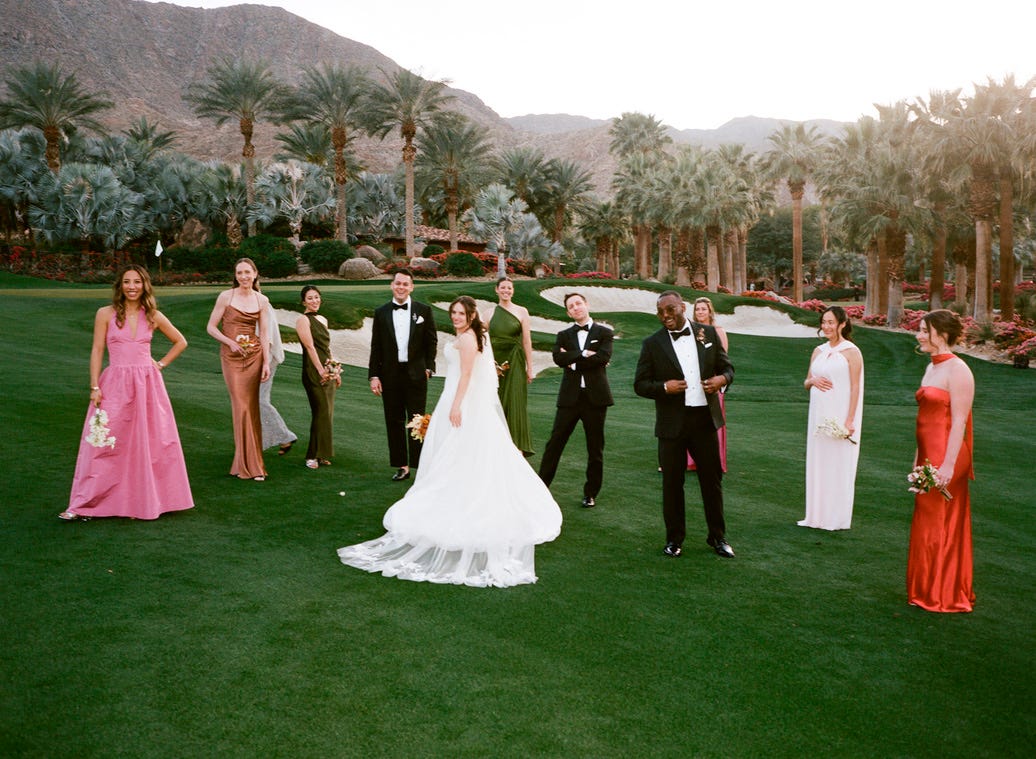
When we first met our photographer, John, in person, he told us he doesn’t deliver photos until six to eight weeks after the wedding. His tone gave me the sense that this sentence signals to some couples that he’s not the right photographer for them. I understand why. I’ve been to north of 40 weddings in the last half-decade, and often my feed is filled with teasers the photographer has already shared by Monday.
When he shared this, I felt my body relax. I’d need more time to understand why, but I knew there was something beautiful about creating space between the event and my externalized consumption of it. John posited that waiting extends the event’s lifetime. If you look at all the photos a week later, it’s just – over. But if you wait a few weeks or a month, you get the anticipation of reliving the event in photographs.
I didn’t see a single photograph from the day for two months.
In that time, I was able to metabolize my thoughts about why I was so grateful for the wait. I had two core theses, which I first explored within myself and then went looking for research on.
The first was that waiting allowed my own experience of the event to crystallize and settle into my long-term memory before being colored by someone else’s lens. The event lived in the images in my mind, the stories shared with friends, and the reliving between Glenn and me.
And the research supported my intuition. A 2024 study examined how the presence of photographs of oneself changes how we remember the events they document. Across three studies with nearly 400 participants, they found that memories tied to photos of yourself are more likely to be retrieved from an observer-like perspective. This means you remember the event from outside your body, watching yourself, rather than from your own eyes as you originally lived it. And the observer perspective has been shown to dim memories: it reduces both their emotional intensity and vividness.3
So the camera doesn’t just preserve the memory. It edits it. Slowly, over time, our recollection drifts from how we experienced an event to how the camera saw us experiencing it. The view from inside is replaced by the view from across the room.
By the time I sat down with John in April and saw the first photos from the weekend, my first-person memory had already had two months to harden. I knew the butterflies and the feel of Glenn’s clammy hand as we walked into the rehearsal. I knew the awe in the room when Mark finished a magic trick. I knew the taste of popcorn shrimp and champagne shortly after our ceremony. I knew the completeness of looking out at every face I love. I knew the energy of the dance floor before I ever saw a picture of it. The photos layered on top of a memory that was already mine. They became evidence of an experience I owned, rather than the experience itself.


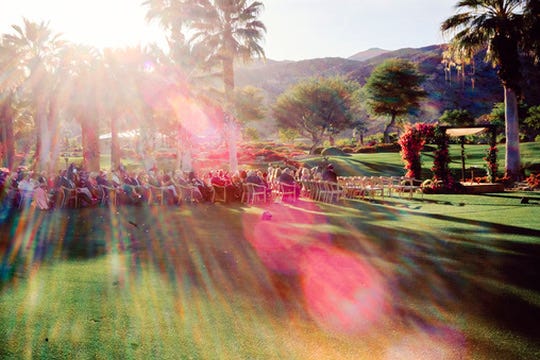
The second thesis was that waiting gave me space to be less concerned with my body image in the photos. My hypothesis was that if I’d seen them the day after, I would have been more concerned with the way I looked than the emotion of the weekend. I’m not above this — when I see a picture of myself, my eye finds the things I don’t like first. The arm that reads as bigger than I think it is. The smile lines that look like a double chin at certain angles. If I’d been handed a thousand photos in the days after the wedding, I would have spent that window scrutinizing my body instead of metabolizing my joy.
This pattern has a name in the research literature: self-objectification. Fredrickson and Roberts described it in 19974 as the tendency, especially common among women raised in appearance-centered cultures, to view our own bodies from a third-person perspective — to see ourselves as something to be looked at and evaluated rather than something to be lived in. Recent meta-analyses have shown that photo-based platforms like Instagram intensify this effect more than text-based ones, and that women experience it more strongly than men.
Here’s what struck me when I started reading: the memory effect and the self-criticism effect aren’t two separate things. They’re the same shift. Both operate by pulling you out of your own eyes and into a third-person view of yourself. The camera’s gaze and the self-critical gaze are the same gaze. Waiting for the photos protected me from both at once
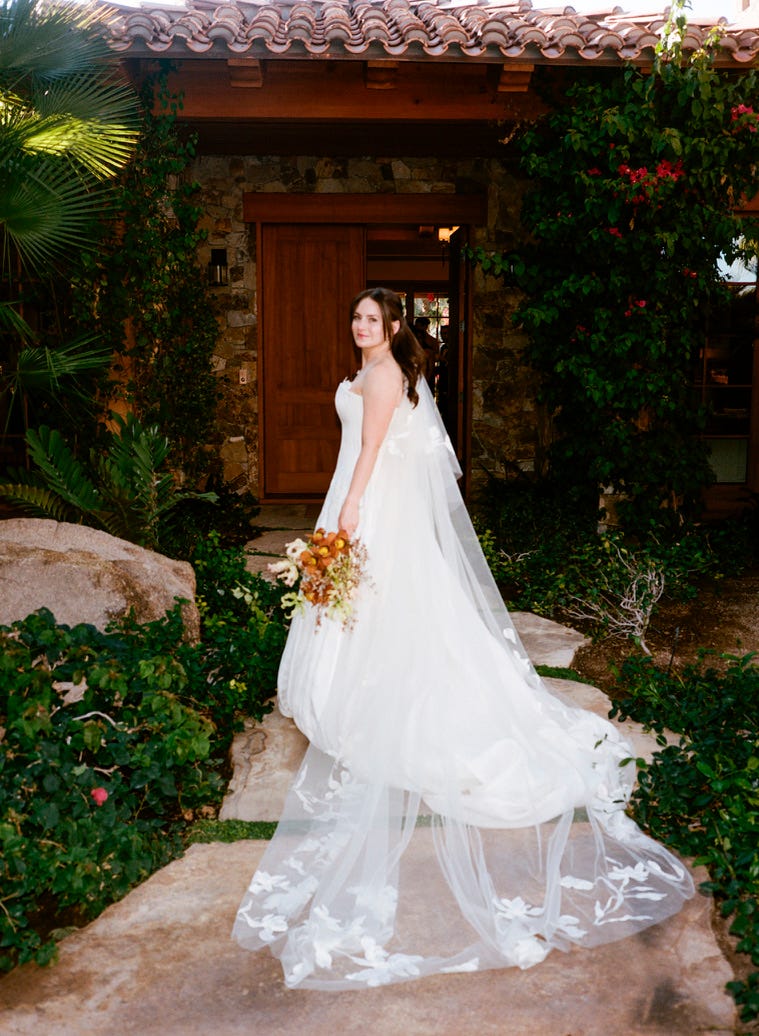
John gave me many gifts. Saying to me “we don’t want to overshoot.” The space between the event and looking at photographs. And how he delivered our photos to us.
He didn’t hand us a thousand frames and let us drown. He selected 18 first — the 18 he believed told the story from his perspective — and we opened them like a present. Only afterward did he hand over contact sheets, over a thousand images across four days and three photographers.
In a world that inundates us with content at every turn, curation is a gift. The first thing I encountered was signal, not noise, and it changed the way I met every photograph that came after.
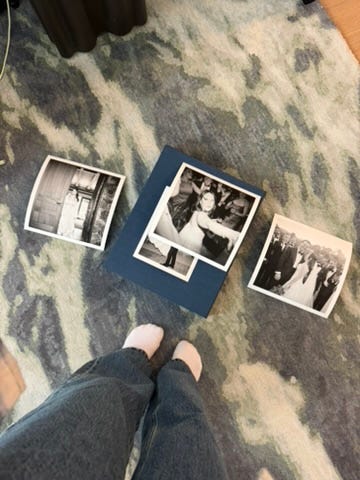
So now it’s been three months, and I’m sharing the photos publicly on Instagram for the first time. And I want to be honest about why it took me this long.
First was, of course, that I myself didn’t look at them for two months.
Part of it was choice paralysis. Over a thousand images — where do you even start? Hello Jam study.
But the deeper reason is that I’ve been sitting with the question of why am I sharing. Why do I share on social media at all?
On the plane ride home from our engagement, two weeks after I said yes, I scrutinized over which photos to share and my caption. I was afraid to post. I wanted it to be acknowledged. And it was — it was my most liked photo of all time. But then that made me sad. Why is getting engaged more celebrated by my community than graduating from Stanford, being at Slack for three years, or starting a company? The metric warped the meaning.
I don’t want some number of likes to cloud the best day of my life. I’m afraid of another lens. I’m afraid of external validation having any power over one of the best weekends of my life.
And there are harder questions underneath that one. Am I posting these because I want people whom I’ve fallen out of touch with to wish they were still my friend? Am I not posting because I’m afraid the person who wasn’t on the small guest list will feel sad about it? Who is my audience, and do I feel good about the answer?
I don’t think I’ll ever have perfectly pure motives. Maybe no one does. Social media has made the act of sharing inseparable from the act of performing, and I’m not above that tension. I scrutinize the way I look. I care what people think. I overthink captions.
But I also know that not sharing is its own kind of overshooting — overthinking, overprotecting, letting the fear of imperfect motives keep me from commemorating my own life. There were so many artists who worked on this celebration. I want them celebrated. There were so many people who made the weekend what it was. I want them to see it.
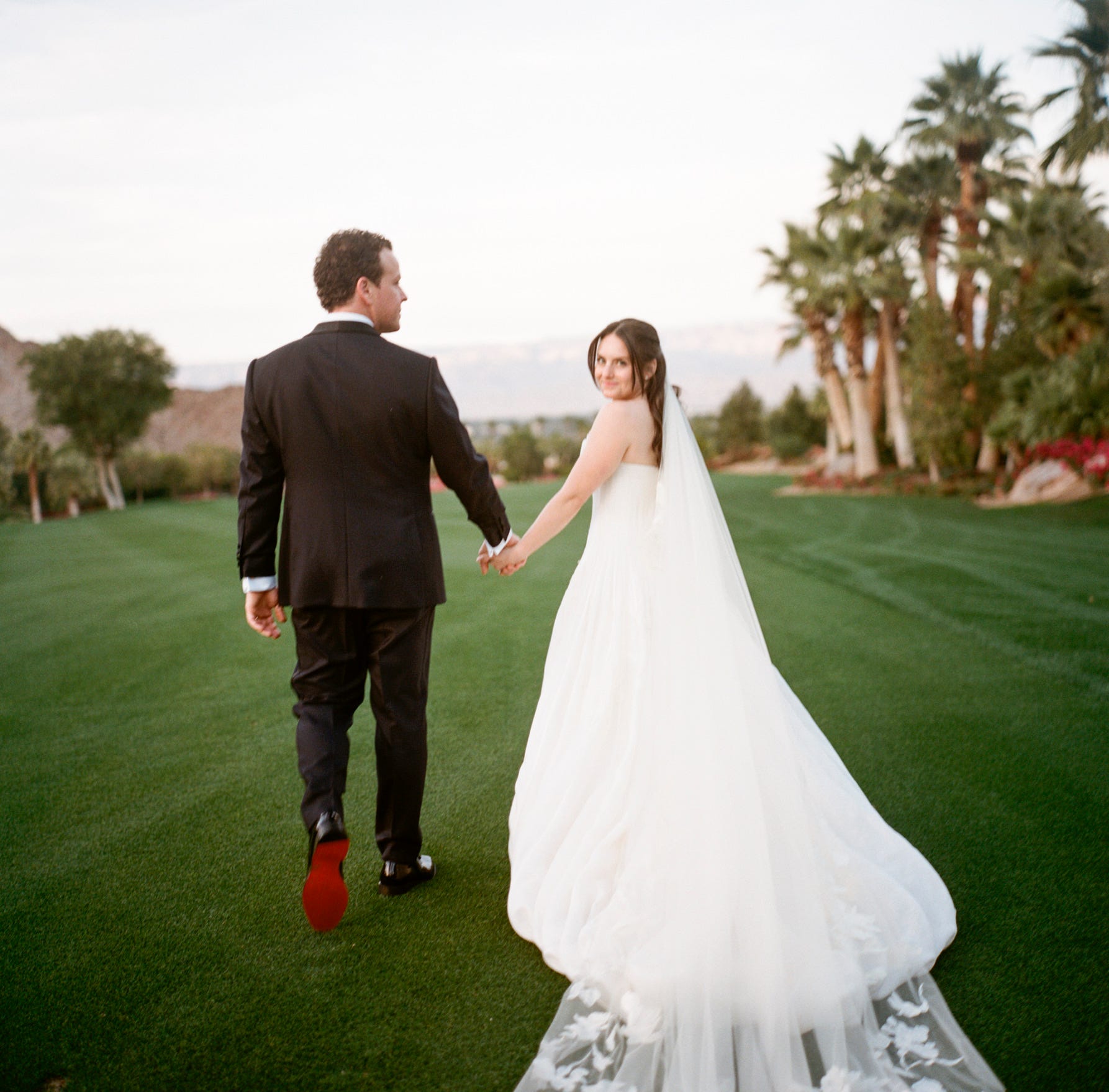
So here are the photos. Not because I resolved the tension, but because I decided the tension doesn’t get to win. John said, “We don’t want to overshoot,” and I’ve been trying to follow his lead — in how I experienced the night, in how I waited for the photos, in how I sat with them before sharing. But at some point, restraint becomes its own form of excess. At some point, you just have to share the thing if it feels right.
Iyengar, S. S. & Lepper, M. R. (2000). When Choice is Demotivating: Can One Desire Too Much of a Good Thing? Journal of Personality and Social Psychology, 79(6), 995–1006.
Gilbert, D. T. & Ebert, J. E. J. (2002). Decisions and Revisions: The Affective Forecasting of Changeable Outcomes. Journal of Personality and Social Psychology, 82(4), 503–514.
King, C. I., Panjwani, A. A., & St. Jacques, P. L. (2024). When Having Photographs of Events Influences the Visual Perspective of Autobiographical Memories. Applied Cognitive Psychology, 38(1), e4150.
Fredrickson, B. L. & Roberts, T. A. (1997). Objectification Theory: Toward Understanding Women’s Lived Experiences and Mental Health Risks. Psychology of Women Quarterly, 21(2), 173–206.
Came here through John and am so moved by your experience.
Sometimes I tell clients I want them to think about their memories like reading the book before seeing the movie (my photos). We all deserve to let our imaginations and memories create something first. Thank you for putting this into words!
I loved every part of this! Made it here from John sharing the link on Instagram and, as a photographer myself who recently got married, I relate to these feelings as a bride and also deeply appreciate this read as a photographer. Took many notes to come back to! Thank you for sharing these words and these photos with us 💌